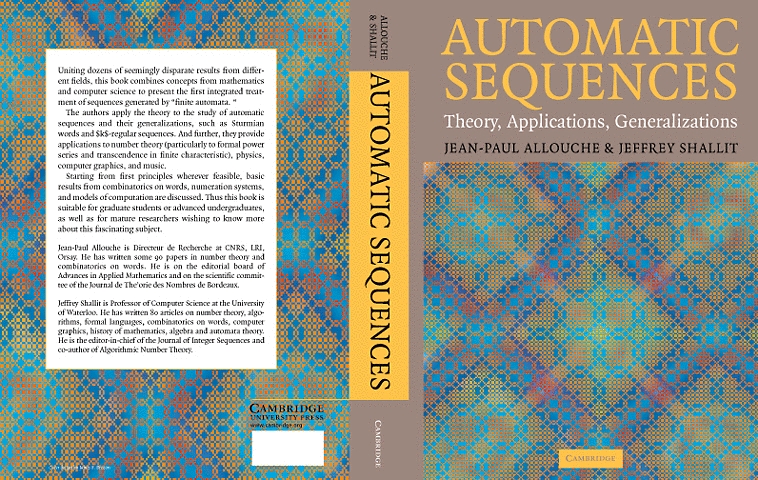
Jean-Paul Allouche
and Jeffrey Shallit
Automatic Sequences: Theory, Applications, Generalizations,
Cambridge University
Press, 2003.
|
|
Jean-Paul Allouche
and Jeffrey Shallit |
 The authors talking to each other.
"I strongly recommend this excellent book to anybody interested in
interaction between theoretical computer science and mathematics."
-- Jean Berstel, Institut Gaspard Monge, writing in SIGACT News,
Vol. 35 No. 1 (March 2004), pp. 12-16
"Every serious sequence lover will want to own a copy!"
-- Neil Sloane, AT & T Research
"...this book will soon become the Bible on the subject..."
-- Jia-Yan Yao, Wuhan University
"It is a wealth of information and I am really enjoying reading
it."
-- Luca Q. Zamboni, University of North Texas
"The book is a successful combination of a monograph (almost
encyclopedic) and an introduction to the subject.
Professional mathematicians and theoretical computer scientists
will find the most important results, applications and examples of
the theory, with motivation, cleverly collected and clearly represented.
Selected applications in number theory, combinatorics on words and
physics show the strength of the theory. Lists of open questions show
the way for further development. All this is supplemented with a
bibliographical notes and comments, and an impressive list of
references...
This is a good and carefully written book by two experts in the field."
-- Guentcho Skordev, University of Bremen
"Allouche and Shallit's book presents an introduction to the fascinating
subject of automatic sequences ...This book, which incorporates results from
both mathematics and computer science, will be very valuable to a large
audience."
-- Francine Blanchet-Sadri, writing in Zentralblatt
See the complete review in Zentralblatt Math.
"Beautifully presented in a concise and scholarly manner, this book
develops the fascinating theory of sequences generated by one of the most
basic models of computation; namely, finite automata... Allouche and
Shallit ... manage to successfully combine a myriad of concepts from a range
of seemingly disparate disciplines to form a coherent and extremely
informative resource for anyone from the professional researcher to
the inquisitive undergraduate student... Applicable to practically all
areas of mathematics and computer science, this book is sure to become a much
celebrated text on infinite sequences of symbols and their applications.
A worthy addition to every mathematician's bookcase!"
-- Amy Glen, writing in Gazette of the Australian Mathematical Society, September 2004
See the complete review.
"The book can serve both as an introduction into the study of automatic sequences, and as a systematic survey of known results and applications. The topic mentioned in the title is far from being the only interesting theme of the volume. Related topics range from combinatorics on words and formal languages through number theory and formal power series to physics. The basic concept is defined in the fifth chapter using finite automata formalism. In the following chapter an equivalent characterization in terms of fixed points of morphisms is given. Properties of automatic sequences bring together in a natural way results from number theory and theoretical computer science, for example, questions of transcendence of numbers and power series. Relations between these areas are often neglected due to different conventions in language and notation. The book presents a lot of results from both fields for the first time in a unified framework. Material is presented in a clear and attractive way with motivation, exercises, open questions, and a very rich bibliography. The presentation is self-contained in a remarkable degree. The book contains a review of various areas needed such as periodicity in words, subword complexity, algebraic and transcendental numbers, numeration systems, finite automata, Turing machines or continued fractions. Famous sequences like Thue-Morse, Fibonacci or Rudin-Shapiro are also studied. The book will be of use for beginners as well as for advanced students and researchers." -- review by Vladimír Souček in the European Mathematical Society Newsletter, Volume 52, June 2004.
I highly recommend Automatic Sequences, whether as text, reference, or all the more as an excellent read, both to rank beginners and to those already acquainted with parts of the subject. -- Alf van der Poorten, Mathematics of Computation, 74 (2004), 1039-1040.
